Although Hope Africa University (HAU) has a relatively new Agriculture Program, the internship and courses need to be reviewed and improved in order to become much more practical and; thereby, ensure that the Agriculture Program Graduates can work well with community farmers to increase their agriculture productivity. Thankfully, the new Rector of Hope Africa University, Dr. Servilien NITUNGA, and the Executive Secretary of the Free Methodist Church of Burundi, Rev. Evariste BIMENYIMANA, are encouraging, supporting and assigning Dr. John McCready of the Haley McCready Outreach and Development Fund (HMODF) to continue to collaborate with others to address the required improvements and enhancements to the entire two-year Agriculture Program.


Fortunately, the enhancements have already begun. With strong support from Rector NITUNGA, Dr. McCready, the HAU Senior Advisor on Development, was given the privilege and honor of designing, developing and organizing an Agriculture Internship Enhancement Program.

From a larger seven-week program, Rector NITUNGA had John organize the coordination and implementation of what became an abbreviated two-week Enhancement Program. The Overall Coordinator of the implementation of the Enhanced Program was Dr. Allan Muhati, Director of the HAU Research Centre and Project Management.

Susan Muchiri, Head of Social Work and Community Development, was the Coordinator of Agriculture and Development and Cyprien NTUNZWENIMANA, Head of the Agriculture Program, was the Coordinator for the Agriculture Program Students. The Free Methodist Church Coordinators were Abraham NTWENGERABANSI and Audace MPAWENIMANA. The Coordinator for the Haley McCready Fund was Dieudonne IRAMBONA.
The practical compost training was the highlight of the program, a very exciting part of the Agriculture Enhancement Program. The first thing that was needed was a practical compost training site nearby the main HAU campus. Since John was involved in supporting the Friends of Hope Africa University, Gina and Travis Sheets’ Exploration that recommended HAU become involved in agriculture education and training, he knew there is a large agriculture centre across the road from HAU and beside the Van Norman Clinic. With the assistance of translators, John made his way across road to the agriculture site. The centre is part of the Ministry of the Environment, Agriculture and Livestock and is involved in market gardening and the promotion of fruits and vegetables.

John then tried to arrange to talk to the Chief and to ask if HAU could use some of their space for training on composting. The Chief’s name is Mr. Eugene MANIRAMBONA.

As soon as the question was asked, Chief MANIRAMBONA was very positive and generous, and he quickly said, if your Rector provides us with a written request for space for compost training, it will be approved. John contacted Rector Servilien NITUNGA, provided the Chief’s name and address and he immediately agreed to write the official request.

After some time passed, John returned to see the Chief. When John asked when he could expect a response to the Rector, the Chief simply opened a file and provided John with a copy of the approved and signed agreement that allows HAU to use some space for practical compost training. Thanks to Chief Eugene MANIRAMBONA, a practical, compost training site was secured.
Once a compost training location was secured, expert composting trainers were required. John returned to his contacts at Foundations for Farming (a program very much like Farming God’s Way); Donna Bloomfield and John IRAK0SE. Dr. John had seen their demonstration composting site and they agreed to come to the Hope Africa University to first provide a presentation on the importance of restoring the soil and then to provide the hands-on practical training on composting.
Donna Bloomfield, who lives in Burundi, is the Founder and a Trustee of a UK Registered Charity; Hope for Tomorrow Global, that partners with churches and, particularly, the City Gate Church that is based in Bujumbura.

Murungwa (John) IRAKOZE is with City Gate Church in Bujumbura and works in partnership with Hope for Tomorrow Global in Foundations for Farming.
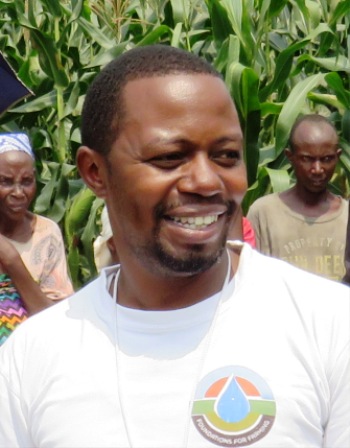
Both Donna and John are well-trained, experienced and highly skilled leaders in promoting and delivering Foundations for Farming in Burundi and they are interested in partnering with us to improve the overall HAU Agriculture Program and to provide practical compost training and practical training and demonstration on high production crop cultivation methods within the Internship Program.
Agriculture Internship Enhancement Program
In brief, the Enhancement Program took place in November. Although the focus here is on the compost training component, the Enhancement Program included the following.
- Presentation on Restoring Soil and Practical Training on Composting
- Presentation on Agriculture and Development
- Distribution of the Kirundi Version of Farming God’s Way Field Guide
- Presentations on the Church’s Community Farming
- Presentation on the Haley McCready Fund’s Agriculture Development Projects
- Field Visit to Foundations for Farming’s Training Centre and Community Farming Projects
- Field Visits to the Church’s Community Farming Projects
Composting
Compost is the result of the natural decomposition of organic matter; the result produced by micro-organisms and, especially, bacteria and fungi. To create compost effectively, it is suggested that you build an above-ground pile of 2 meters by 2 meters by 2 meters. The pile is built by creating repeated layers of 10 cm of twigs (woody material), then 10 cm of brown (dry plant material), then 20 cm of green (fresh plant material) followed by two bags of manure.
As planned, the expert Foundations for Farming training team arrived at HAU to provide the presentation and continue with the practical hands-on compost training.

From left to right with Dr. Muhati in the middle, Jermie MIBURO, Jean Marie NTAKIRUTIMANA, Venuste KARERWA and John IRAKOZE were the expert Foundations for Farming compost training team. Composting is natural and organic (no chemicals) and much less expensive than buying fertilizer. Anyone can learn to make compost. Compost is considered to be the best plant food on earth. For the practical training, the compost generating material had to be at the site ahead of time.
Requirements for Compost Training:
- Water
- Manure
- Green plant matter
- Brown plant matter
- Small wooden twigs
- A small long metallic rod about 2m long
- Four long poles for marking out the compost site
- One tape measure
- Basins or a large water container
- Copies of the Foundations for Farming composting presentation
The required materials were brought to the site and the presentation on the importance of and the methods for restoring the soil was provided by John IRAKOZE of Foundations for Farming.

After the presentation, the HAU Agriculture Program students and a other participants went to the compost site and participated in the Foundations for Farming practical, hands-on compost training.


Now, Rector Servilien NITUNGA has given Dr. John McCready a new assignment; to organize a Work Team from the University, the Church, the Haley McCready Fund and other partners to review and improve the entire Agriculture Program. The assignment is to enhance the internship and the courses by adding a more practical content and approaches that emphasize practical knowledge, practical skill development and direct, hands-on community farming experiences. Since the second-year students will be involved in their internship starting in July and graduating in February, the immediate efforts will be focused on developing and implementing a full, enhanced internship and later reviewing and enhancing the courses.
To support the Haley McCready Outreach and Development Fund, visit http://haleymccreadyfund.com/u-s-donations/